

Addressing Parliament, Khanal emphasized that Nepal remains firmly committed to resolving all outstanding border concerns through diplomatic dialogue and negotiations based on historical treaties, agreements, and maps, while preserving the spirit of the close relationship between the two neighboring countries.
"What I would like to clarify in this esteemed House is that the Nepal-India border is a bilateral issue and Nepal is always committed to resolving this problem through diplomatic dialogue and negotiations based on historical treaties, agreements and maps in accordance with the spirit of the close relationship between Nepal and India," Khanal said.
The clarification follows a political controversy triggered by remarks from Nepal Prime Minister Balen Shah, who suggested that China and the United Kingdom could be involved in addressing the long-running border dispute. His comments prompted criticism from both the Indian government and Nepal's domestic opposition.
Khanal stated that the Prime Minister's remarks should not be interpreted as a request for mediation. According to the Foreign Minister, Shah merely indicated that historical reference materials from the period of the Sugauli Treaty could serve as supplementary resources for the ongoing technical process if such records were available.
"The issue raised by the Prime Minister in Parliament is basically related to the encroachment of the no-man's land area and cross-border occupation," Khanal said.
He added that border-related mechanisms and technical teams from Nepal and India are actively engaged in mapping activities, maintaining border pillars, and collecting data concerning encroachment and occupation along the frontier.
"The border-related mechanisms and technical teams of the two countries are active in the areas where the long border between Nepal and India has been systematically and scientifically mapped, to construct and maintain border pillars, collect data on encroachment of the no-man's land area and cross-border occupation," he said.
Khanal further explained that the Prime Minister's concerns were primarily focused on practical challenges arising from cross-border occupation and encroachment within designated no-man's land zones.
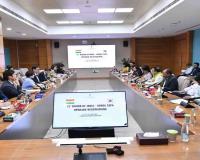
He noted that the work of the technical committee, which had remained stalled for a prolonged period, has resumed in border regions and that joint data collection efforts are currently underway. According to Khanal, the Nepal-India Boundary Working Group and other border-related mechanisms are conducting mapping exercises to identify locations affected by no-man's land encroachment and cross-border occupation along the Nepal-India border.
"The Nepal-India Boundary Working Group and other mechanisms related to the border are conducting mapping work on the locations of no-man's land encroachment and cross-border occupation along the Nepal-India border. Detailed details on this matter will be available later," he said.
India also responded firmly to Prime Minister Shah's earlier remarks. Ministry of External Affairs spokesperson Randhir Jaiswal reiterated that bilateral matters between India and Nepal must be resolved exclusively by the two countries without the involvement of any external party.
"We have seen the remarks of the Prime Minister of Nepal concerning the India-Nepal boundary as well as the subsequent statement made by the Nepali foreign office on this matter. All concerned parties should be clear that any bilateral matters between India and Nepal are to be resolved solely between the two countries, and there is no role for any third party in such matters," Jaiswal said.
He further stated that approximately 98 percent of the India-Nepal border has already been demarcated, with only a few sections remaining unresolved.
"Approximately 98 per cent of the India-Nepal border has already been demarcated. However, a few issues remain unresolved in certain sections. This situation has arisen due to changes in the course of the Gandak River," he said.
Jaiswal also acknowledged the existence of cross-border encroachment and encroachments on no-man's land in some demarcated areas, noting that these locations are currently being jointly mapped by both countries.
Prime Minister Shah had earlier stated that, alongside discussions with India regarding the Lipulekh Pass dispute, Nepal had also maintained contact with China and the United Kingdom.
"Since this problem dates from the time when British India left the region, it is our view that England should be involved in this matter," Shah said.
During his first appearance in the ongoing parliamentary session as Prime Minister, Shah also made a notable observation regarding territorial issues along the border.
"You will be surprised to know a fact that I learnt only after becoming Prime Minister. It is not only India that has encroached on Nepalese territory, but Nepal has also encroached on Indian territory in many places," he said.
The latest clarification from Nepal's Foreign Minister underscores Kathmandu's official position that all outstanding border issues with India will continue to be addressed through bilateral diplomatic mechanisms. The statement seeks to ease tensions generated by recent political remarks while reinforcing ongoing technical cooperation between the two countries on border mapping, pillar maintenance, and the resolution of disputed areas.
About The Author



.jpg)
-(1).jpg)





Comment List